2024. The requested answers come back
January’s Design Commission review
When the designs reached the Design Commission in January 2024, its formal assignment was to advise the Council on aesthetic design concepts. The discussion nevertheless moved beyond the appearance of the three designs and returned to whether other safety measures might work.33
Chair Julianna Delgado cited the Golden Gate Bridge and asked whether horizontal netting, landscaping, or another measure could be used instead. An off-camera speaker said horizontal netting had been studied since 2017 and traced the City’s vertical-barrier direction to the task-force review and the Council’s 2018 decision. According to the speaker, a net would create construction, rescue, training, equipment, cost, and architectural problems specific to the Colorado Street Bridge. They said the research the City had reviewed supported a vertical barrier as the most effective option. They also noted that the City’s previous consultant, Donald MacDonald Architects, had served as lead designer of the Golden Gate system and had considered dozens of alternatives for Pasadena before the City retained a new consultant.5,6,33
Delgado then asked whether the public had been shown a horizontal option. The speaker said it had, but that the Council had directed the City to pursue a vertical barrier. Delgado replied that this was “a previous City Council and a long time ago.” One commissioner said the Golden Gate and Colorado Street bridges were structurally different and that a net below the Colorado Street Bridge would compete with its arches. Delgado argued that a net could be placed farther below, suggested planting cacti beneath the bridge, and repeated a public suggestion to construct apartment buildings there. A responding speaker noted that bungalows already existed below the bridge and said the safer approach was to keep people from leaving the bridge deck.33
Later in the meeting, Delgado said she couldn’t support any of the three designs. She said there had to be a better solution and that she didn’t want any of the presented barriers on the bridge.33
Other commissioners expressed different preferences. Pasadena Now reported that Srinivas Rao favored the canted mesh but wanted further refinement. Marie-Claude Fares preferred webmesh and criticized the effect of pickets on views from the bridge and its surroundings. Robert Carpenter said he found it difficult to accept any of the proposals.50
The commission did not reach consensus on any of the designs. Its advisory comments called for further study of the metal pickets and canted webmesh, including the angle and details of the canted design, and consideration of combining pickets with webmesh.33
July’s committee review
When the project returned to the Public Safety Committee in July 2024, staff gave a more detailed answer to Delgado’s question about horizontal netting. By then, staff’s options had narrowed to vertical webmesh and metal pickets. The July presentation listed canted webmesh as eliminated. Staff also returned with much of what elected officials had asked for, including patrol costs, technology analysis, horizontal-netting research, Golden Gate consultation, rescue concerns, survey results, and suicide-prevention expertise. 16
The committee also heard from Bonnie Tang, whose son Nicholas died by suicide at the bridge in April 2021. She shared her family’s loss as part of the presentation. Committee members expressed condolences and thanked her for speaking.18
Horizontal netting came back with a much fuller engineering and rescue review. The original 2018 task-force comparison had rated it relatively highly for effectiveness but poorly for aesthetics and its impact on emergency services.17 By 2024, after preliminary site-specific engineering work and direct consultation with Golden Gate Bridge officials, Pasadena’s review concluded that horizontal netting wasn’t a viable solution for this bridge.16,18
Fire Chief Chad Augustin explained what a rescue could require. Someone who landed on a net could be 10 or 20 feet below the bridge, making it difficult for police to determine whether the person had a weapon or whether rescuers could safely approach. A rescue could require both of Pasadena’s ladder trucks for hours, along with specialized equipment and additional training. Augustin supported having a barrier on the bridge, but he couldn’t recommend horizontal netting from a public-safety standpoint.18
2017 · Safety-netting concept
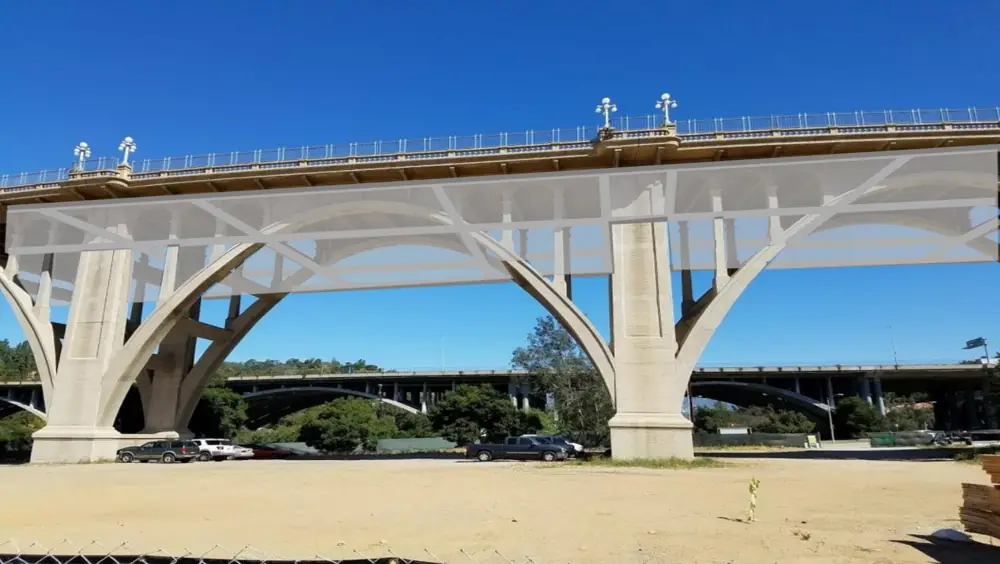
2024 · Preliminary horizontal-netting Option 1
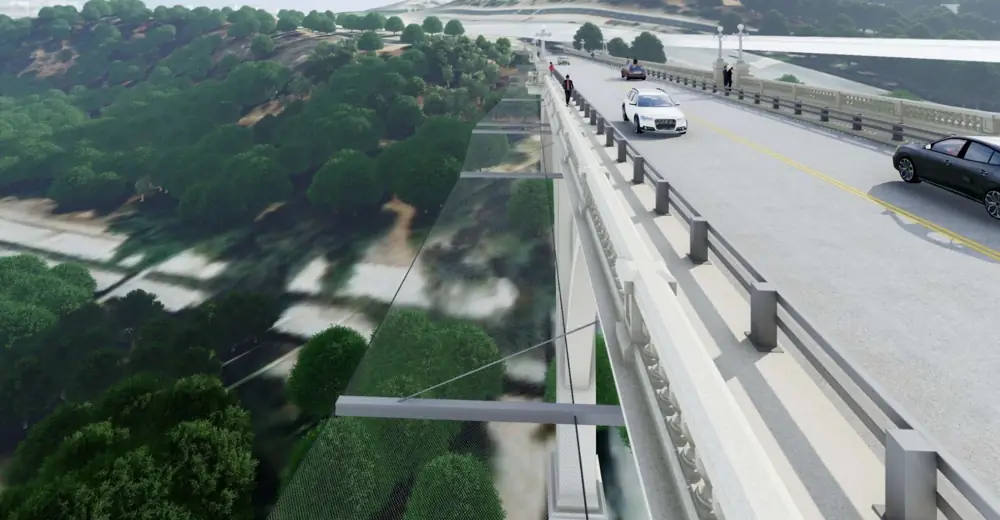
Figure 8. Horizontal-netting concepts presented in 2017 (top) and 2024 (bottom). Renderings of proposed designs, not built conditions. City of Pasadena.
The committee also received the requested patrol costs. The estimate was roughly $600,000 a year for private security and about $1.16 million a year for law-enforcement coverage. Even at those levels, patrol wasn’t considered an effective substitute for a physical barrier.16
The public survey drew 678 responses overall. The City reported that 57% of those answering the need question said a vertical barrier wasn’t needed and 43% said it was. Asked separately whether a vertical barrier would help prevent suicides, 40% said yes, 33% said no, and 27% didn’t know. Some respondents skipped the design ranking, so the overall response count should not be assumed to apply to every question. People chose whether to take the survey, so its results cannot be treated as the views of Pasadena residents as a whole. Staff said 90% of respondents were Pasadena residents, and 74% said they hadn’t participated in the project’s community meetings.19
Among respondents who ranked the designs, metal pickets came first, while the Historic Preservation Commission had preferred vertical webmesh. Lighting drew broader support. The City reported 81% support for added lighting in the survey, and the commission unanimously supported lighting under the balustrade.19
Markarian, then acting director of Public Works, said they pointed to a need for “additional education.” Sandri Kramer of Didi Hirsch was even more direct. With roughly 60% of respondents either unconvinced that a vertical barrier would prevent suicides or unsure whether it would, she called it a “public education issue” and explained why restricting access can save lives.18,19
Kramer focused on the time between suicidal intent and an attempt. She explained that restricting access can give the immediate danger time to ease or give someone a chance to intervene. 19
A separate study of England’s Clifton Suspension Bridge illustrates how that can work. After barriers were installed, bridge staff reported that they had more time to reach people, while deaths fell even though the number of incidents did not. The bridge also used cameras and staff patrols.29
Members weigh the next step
Jones’s questions moved the discussion toward a decision. He asked whether 24/7 patrol was being ruled out because of cost, effectiveness, or both. Staff said both. He then asked whether anyone involved in the expert review had recommended horizontal netting. Staff said no. The recommendation against it had been unanimous. After hearing those answers, Jones said he was prepared to move forward with one of the two remaining designs.18
Hampton pressed for a faster timetable. He asked staff to return in about 90 days and said vertical mesh was his preferred permanent design. He also raised cameras and motion detection as possible supplements. Later in the discussion, staff said horizontal netting hadn’t been recommended, and Fire explained its rescue concerns. Hampton said he didn’t want netting taken off the table. He still considered it the most attractive of the alternatives. 20, 21
During that follow-up, Hampton asked about rescue cushions. Fire Chief Chad Augustin said Pasadena’s cushion was rated for roughly 100 feet, while parts of the bridge are about 150 feet high. The equipment also couldn’t be positioned everywhere below it. Hampton then asked whether a higher-capacity cushion existed, a question the City hadn’t already answered. Fire didn’t know and agreed to investigate. A May 2026 Fire Department presentation listed a rescue cushion among its response resources, but gave no capacity rating. The equipment list doesn’t answer Hampton’s question. 21
Eight months after the November discussion of netting and landscaping, Madison again turned to measures below the bridge. He said the City needed an engineering solution and asked about ground cover, physical impediments, and layered netting. Staff and consultants again explained the limits involving fall distance, structure, cost, and what those measures would do to the appearance of the bridge. Madison also repeated his view that human life and safety had to come before objects.18,22
During that exchange, Madison acknowledged that leadership sometimes meant proceeding without a great option. He asked Markarian, “Do you feel like we’ve really done our level best to exhaust all the feasible options?” Markarian described more than seven years on the project and experts with different perspectives. She said, “we have truly exhausted various mitigation measures,” before discussing the Golden Gate comparison.18
Gordo asked about cameras and real-time remote communication with a person on the bridge during a crisis. Staff considered these tools possible additions to a physical barrier.18
Jones supported moving forward with one of the two remaining vertical designs, and Hampton preferred vertical mesh. Horizontal netting, below-bridge alternatives, and technology remained in the discussion. No permanent design was sent to the full Council. Staff proposed further design work, public feedback, and commission review before a return to the committee in early 2025. 18, 20, 21