2021. Selection is deferred
By August 2021, more than three years had passed since the City Council’s April 2018 decision to pursue a vertical barrier. The project had involved design work, public outreach, commission review, and full-scale mockups. The committee now had to decide whether to recommend a design, keep the temporary fence in place for the time being, or take another course.7,9
Responses to the mockups
Option B led among the 1,038 respondents who ranked the mockups. The public survey drew 2,268 responses overall.
| Design | Votes | Share |
|---|---|---|
| Curved-curved mesh (Option B) | 462 | 44.5% |
| Pickets (Option C) | 360 | 34.7% |
| Curved-straight mesh (Option A) | 216 | 20.8% |
Separately, staff reported that 44% of 622 comments preferred no barriers and a return to the bridge’s original state. These were different response groups. Participation was self-selected, so neither result represents Pasadena residents as a whole.9
After reviewing full-scale mockups, the Historic Preservation Commission voted to recommend Option B with modifications. This was the mesh option the City called “curved-curved.” Its barrier curved inward over the walkway along the entire bridge. Option A curved at the lamp posts and alcoves, with straight sections elsewhere. The Design Commission preferred straight mesh panels between the alcoves and requested further study to improve transparency around the alcoves and light poles. When the issue reached the Public Safety Committee, Pasadena Heritage executive director Sue Mossman said the task force itself still hadn’t agreed on a final design.9
The designers had explained their reasoning at the March 25 open house. Steve Line of Donald MacDonald Architects described mesh as a way to preserve views while making the barrier difficult to climb. He said straight pickets would require a taller structure and changes to the light standards, and would appear more obstructive when viewed at an angle. Those judgments helped explain the team’s preference for mesh.49
Community groups disagreed about the designs and what should happen next. Pasadena Beautiful urged the City to reconsider horizontal netting. 42 Pasadena Heritage didn’t find any of the three mockups acceptable as presented and asked for options that better fit the bridge. 43 In June, the West Pasadena Residents’ Association asked the City to delay implementation while alternatives were studied further. 44
In an August letter, former Pasadena resident Kathleen Clary Miller recalled crossing the bridge as a child and described how much it still meant to her. She supported a permanent barrier and hoped the design would preserve the bridge’s character. 45
A · Curved-straight mesh B · Curved-curved mesh C · Straight pickets
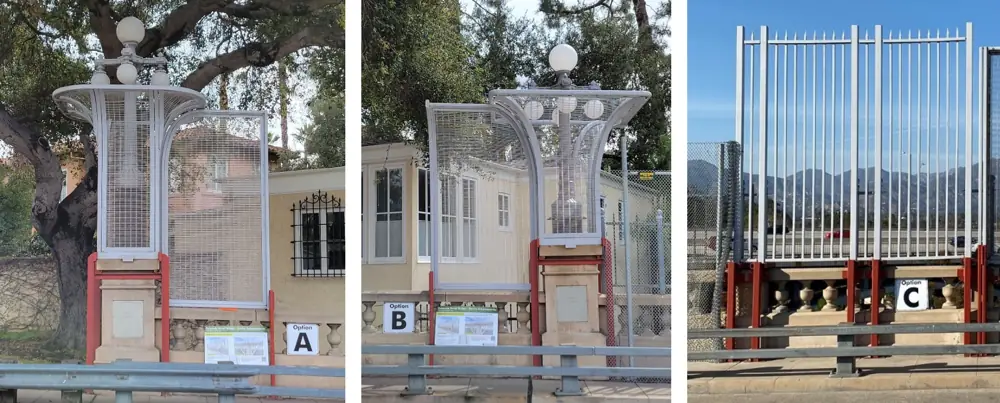
Figure 6. Full-scale mockups from 2021. The red supports were temporary and not part of the proposed designs. City of Pasadena / Donald MacDonald Architects.
Mossman had made the preservation problem plain as early as 2018. Keeping people from the edge was only one goal. The harder task was protecting people while preserving the bridge’s historic character and appearance.23
The August committee discussion
At the August 18, 2021 Public Safety Committee meeting, Madison said the temporary fencing had been effective. He also brought up “coupling,” a concept he recalled from Malcolm Gladwell’s 2019 book Talking to Strangers. Gladwell’s account draws on peer-reviewed suicide-prevention studies. The idea is that a suicidal crisis can become tied to a particular place or method. Making access harder can interrupt an attempt without necessarily moving it somewhere else. 11, 30, 32
Researchers use the term “suicide hotspot” for an accessible place where people repeatedly die by suicide and that becomes known for those deaths. A Vancouver study found that some people chose well-known bridges over others closer to home. The researchers suggested that a bridge’s reputation might help explain that pattern.40
On the design question, Madison was not ready to choose. He proposed narrowing the field to two options and taking them through another round of community input.9
Kennedy, who had chaired the committee in 2017, wanted to narrow the options and put the project on a timetable. At the same time, he supported going out “one last time” for additional local expertise to help the City get the decision right.2,9,11
An earlier proposal from Kennedy was also still under consideration. Back in February 2020, he had asked for a cost estimate for enclosing the bridge with a roof before the Council considered it. The February 2020 presentation compared straight mesh, pickets, curved mesh, and a hybrid. Its schedule called for installing mockups in March, commission reviews in April, and a committee recommendation and Council approval in May. 4, 10 The City later showed an initial enclosure concept to the task force, including Pasadena Heritage and police and fire representatives. The concept wasn’t accepted because of concerns about appearance and safety. 10
At that August meeting, Steve Line of Donald MacDonald Architects presented refined enclosure concepts to the committee. He said one performed especially well when measured against the team’s three design goals of effectiveness, historic compatibility, and appearance.11
Hampton said he had thought Kennedy’s original enclosure idea was a strong one, but wanted something that looked less modern. Madison was more skeptical. He questioned whether preservation advocates or the broader public would accept a barrier that fully enclosed the bridge. Kennedy, who had raised the idea, was now ready to move away from it and narrow the field to the vertical-barrier options.9,11
When Mayor Victor Gordo, who chaired the Public Safety Committee at the time, spoke later in the meeting, he picked up the idea Madison had raised about place and method. He said the temporary structure appeared to be working and that “the decoupling, if you will, has started.” But he still didn’t think the committee was ready to narrow the permanent designs and called for more options and more public input.11
Gordo also took up Kennedy’s enclosure concept. He said he had initially thought full enclosure would never work and had pictured something more like a tunnel. After seeing the refined work, however, he said he liked “the idea of pursuing the material,” wondered whether a different material could be used for the arch-like elements, and said the City shouldn’t rule the concept out.9,11
Staffing and further review
Hampton also said the temporary structure was working and proposed staffing the bridge 24 hours a day. City Manager Steve Mermell said staffing had been suggested before, would likely cost several hundred thousand dollars a year, and wasn’t feasible as a replacement. He recommended leaving the temporary structure in place until a permanent solution was found.11
Gordo used Pasadena’s former Host/Guide program as a model. Trained people would carry radios and serve as additional eyes and ears. He suggested pairing that approach with the City’s ROSE youth-employment program, docents, or tours. Madison pointed to the bridge’s length, curvature, and how quickly some incidents happen. Kennedy raised liability and intervention concerns. Gordo asked staff to see whether staffing could work alongside a physical barrier. 11
“Get it right” became a refrain during the meeting. Mermell, Kennedy, Gordo, and Hampton used the phrase or variations at least nine times, eight within a span of 25 minutes. Near the end, Mermell summarized the requests for more time and a faster result. He then said three months was probably too aggressive and acknowledged that the process ahead would take longer.11
Kennedy also wondered whether the pandemic might help explain why no deaths were recorded at the bridge in 2020 and suggested the question was worth studying. Deaths had already fallen to one in 2019, before the pandemic.3,11
The committee made no selection. The project went back for more design work, community input, and analysis.9,11
John J. Kennedy died on July 21, 2022, while serving on the City Council and only weeks after winning reelection. He had represented District 3 since 2013. Justin Jones was appointed later that year to represent District 3 and would take Kennedy’s place in the bridge discussions that followed. He later won the seat in the March 2024 special election.12