2023. Previously considered alternatives return
Apexx worked with community and preservation representatives and gathered public input as it developed a new set of barrier concepts. By the November Public Safety Committee meeting, three were under consideration. They were canted webmesh, vertical webmesh, and metal pickets. The webmesh designs used metal mesh stretched between posts, either upright or angled. The picket design used a row of closely spaced vertical metal bars.13,14
Canted webmesh Vertical webmesh Metal pickets
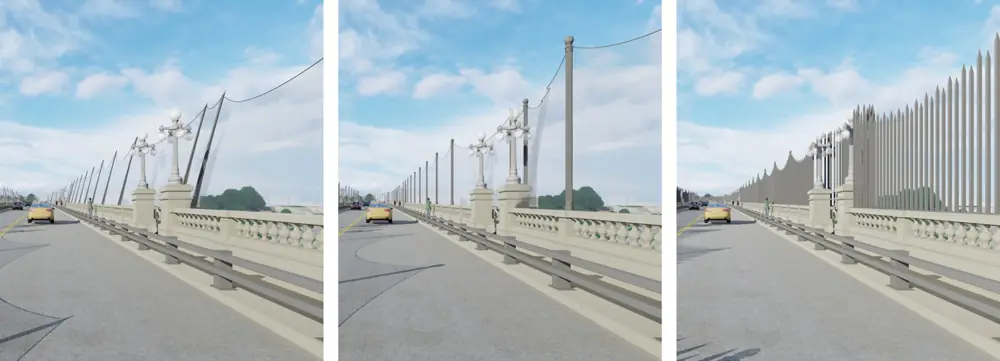
Figure 7. Three proposed barrier concepts presented in November 2023. Renderings of proposed designs, not built conditions. Apexx Architecture / City of Pasadena.
At that meeting, the committee returned to questions Pasadena had considered before. Madison, who had moved approval of the task force’s recommendation in 2018, described many suicide attempts as crisis-specific and impulsive and recalled a documentary about people who had survived attempts at the Golden Gate Bridge.6,14
Madison turned to the new designs. He said they would “completely change the aesthetic of the bridge,” while also saying the City had to “elevate human safety over aesthetics and objects.” He added, “But if there’s a way to accomplish both goals, I think we’re going to be more successful.”14
Madison then asked about horizontal netting and landscaping below the bridge. Staff said both had already been studied. Staff explained that the Golden Gate approach did not translate neatly because of the Colorado Street Bridge’s geometry, the remaining fall distance, structural demands, and the appearance of a net below the arches. The 2018 task-force recommendation report said “no verifying scientific data was found” for planting trees below the bridge to “cushion” a landing or discourage an attempt. The same report said trees could not be planted along approximately one-fifth of the span, including its highest point. The task force treated trees as a possible supplement to a vertical barrier.5,14
After hearing those answers, Madison wasn’t ready to support any of the three permanent designs. He suggested the temporary fencing might be preferable to what was being proposed and said it would take a significant change in community sentiment for him to support one of the three concepts.14
Jones was newer to the bridge debate. He hadn’t been part of the Council’s 2018 decision or the committee’s 2021 discussions. At the November 2023 meeting, he raised concerns from residents who disliked both the temporary fencing and the proposed permanent designs. He asked what other options were available. Staff said the alternatives had already been studied extensively and the Council had chosen to pursue a vertical barrier. 12, 14
Jones also asked how involved Public Health had been in the new working group. He wanted to know whether restricting access at one site simply shifted attempts elsewhere. Staff pointed to the mental-health specialist involved in the process. They explained that interrupting access to a selected site generally didn’t send people to the next bridge and agreed to bring health professionals when the project returned. The Council had considered the same question on April 23, 2018, when Public Health said research showed an overall decline after barriers were installed. 7, 14
Gordo returned to the staffing idea he had raised in 2021. Deputy Director of Public Works and City Engineer Kris Markarian said the City had already examined staffing and didn’t consider it cost-effective. Covering the bridge would require several people and a continuous presence. It’s long, curved, and can’t be seen from one point. She also cited liability concerns and incidents outside regular working hours. Staff considered stationed personnel a possible supplement to a physical barrier. 15
Gordo asked for a more specific assessment of trained security at night and Park Safety specialists, docents, or volunteers during the day. Madison questioned whether personnel could respond quickly enough because some incidents can “unfold in five minutes.” Gordo asked staff to consult mental-health professionals about whether a visible human presence could deter an impulsive attempt.15
Near the end of the November 2023 meeting, Public Works Director Tony Olmos and Markarian again explained that a barrier buys time.14
No permanent design was selected. The committee kept the planned commission reviews and public survey moving while asking staff to return with additional work on staffing and other alternatives.14,15
At its December 5, 2023 review, the Historic Preservation Commission recommended vertical webmesh as its first choice and metal pickets as its second.16