An analytical history
The fence everyone can see
Reading edition · October 22, 2026 · About 40 minutes, excluding Sources
Main research cutoff: September 1, 2026. Later checks and additions are dated where they appear.
Section 1 of 13 · Open chapter
The bridge and its history
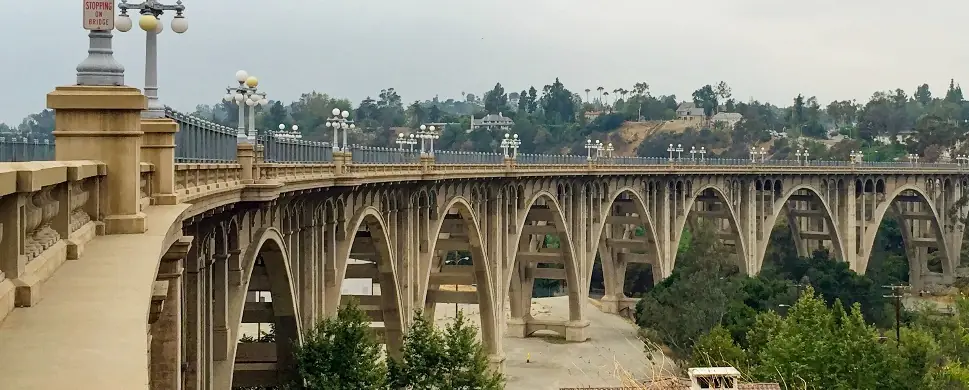
Figure 1. The bridge after its 1993 restoration, showing its curve and arches across the Arroyo Seco. BCA Associates.
The Colorado Street Bridge has carried two reputations for generations. It’s one of Pasadena’s great landmarks, a 1913 concrete span over the Arroyo Seco that has become part of the city’s identity. It’s also known as “Suicide Bridge.”2,35
Before it opened, crossing the arroyo meant descending into the ravine and climbing out again. The earlier wooden Scoville Bridge crossed the stream below, leaving travelers to negotiate the steep approaches. That was difficult for horse-drawn vehicles and early automobiles. The new bridge carried Colorado Street across the ravine at street level.48
Engineer John Alexander Low Waddell’s design was adapted by builder John Drake Mercereau.1 Its sweeping curve helped the builders avoid unstable ground when placing the foundations. Construction began in July 1912. On December 13, 1913, residents celebrated the opening with a parade of decorated automobiles.48
The bridge later carried Route 66 across the arroyo.48 An earthquake retrofit and restoration completed in 1993 reconstructed its concrete balustrades and seating alcoves and restored the historic lighting design.36
The bridge is listed on the National Register of Historic Places, documented by the Historic American Engineering Record, and designated a Pasadena Cultural Heritage Landmark. Pasadena’s Bridge Party, a tradition dating to 1978, celebrates the bridge and the efforts to preserve it.1,37
Its big-screen history reaches back to Charlie Chaplin’s The Kid (1921), which used the bridge for a scene in which Edna Purviance’s character considers suicide.38 Nearly a century later, it appeared in La La Land (2016).39 The bridge has been a setting for stories, a gathering place, and a landmark people have worked to preserve. But its other history never went away.
Section 2 of 13 · Open chapter
2017–2018. An emergency response to an old problem
By 2017, that other history had become impossible to ignore. The City counted 28 deaths by suicide at the bridge from 2006 through 2016, and staff reported an increase in suicides and attempts. On July 19, staff gave the Public Safety Committee a presentation on deaths at the bridge and possible ways to prevent them.2,3
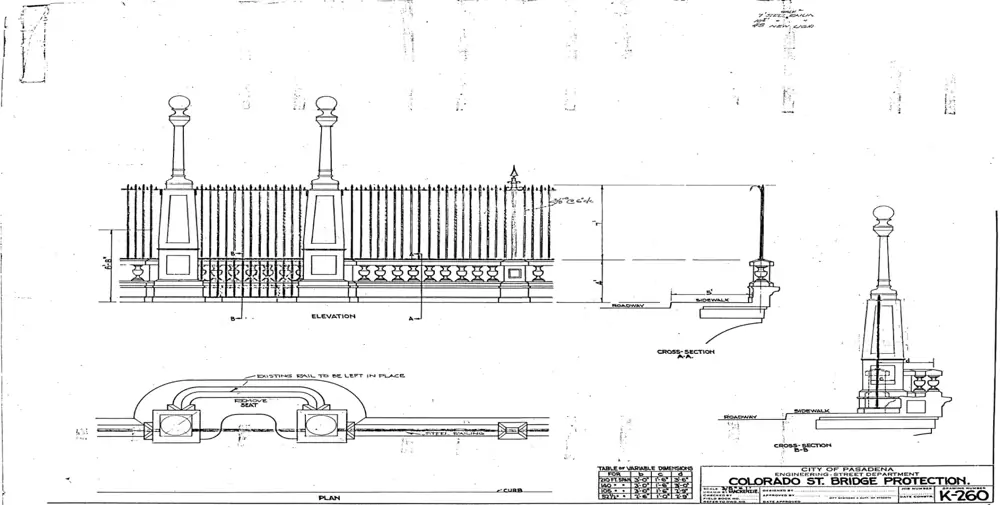
The presentation also put those deaths in a longer context. It reported more than 150 deaths by suicide at the bridge since 1919, including an estimated 79 during the 1930s. It showed fencing and netting designs the City had drawn up around 1932 and said a police detail at the bridge during that decade cost $20,000 a year.2
Fence proposal · circa 1932
Netting proposal · circa 1932
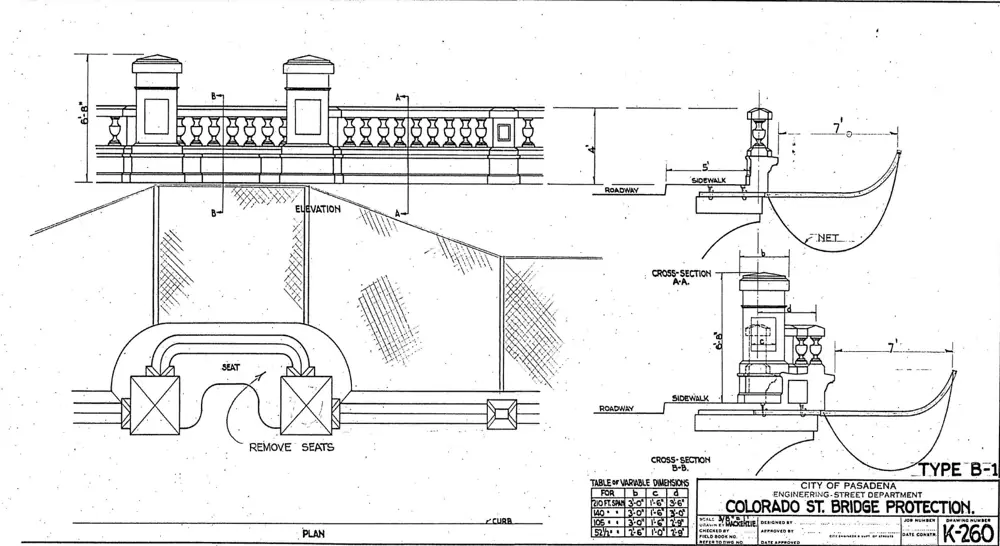
Figure 2. City engineering proposals reproduced in the 2017 presentation. These drawings show proposed designs, not installed conditions.
Even then, a barrier did not come quickly. A Glendale News-Press account said Pasadena moved slowly amid concerns about how safety measures would affect the bridge’s appearance, and the City did not install a 7½-foot mesh fence topped with barbed wire until 1937. Writing in 1992, the Los Angeles Times reported no deaths by suicide from the bridge during the two years after the fence was installed. Deaths later resumed, but the newspaper said no single year had again reached the levels recorded during the 1930s.35
That fence was later replaced. By 1956, Pasadena had installed an iron barrier that curved toward the sidewalk, and that work removed the bridge’s original concrete railing and seating alcoves. In 1989, the City was planning an earthquake retrofit of the bridge. The Los Angeles Times reported that the project would include reworking the iron barrier to reduce what it described as a “tunnel effect.” The City completed the retrofit in 1993, rebuilding the historic concrete railing and seating alcoves and installing wrought-iron fencing above the railing.2,36
Mesh fence · 1937 Inward-curving railing · 1988
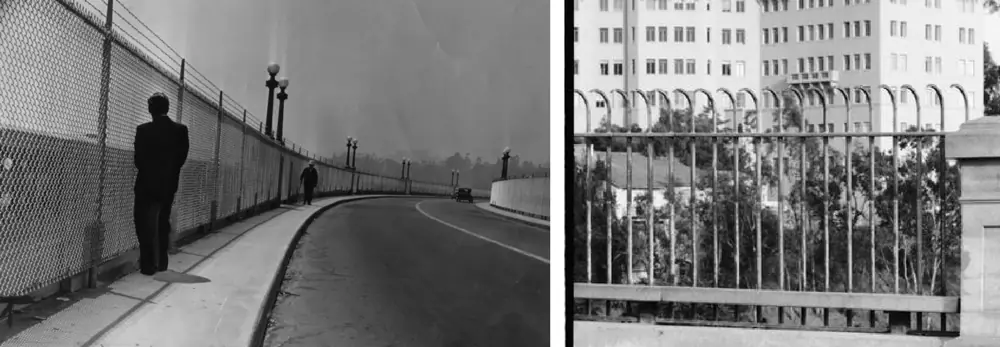
Figure 3. The mesh fence topped with barbed wire in 1937 and an enlarged detail of the iron railing in 1988. Los Angeles Public Library / Tavo Olmos, Historic American Engineering Record.
That was the bridge the committee was considering in 2017. Staff said the rebuilt concrete railing and safety barrier together stood nearly eight feet high. But the way they fit together created footholds that reduced the effective barrier height to about four feet. Staff also identified all 20 restored alcoves and both ends of the bridge as places where people could climb over or get around the barrier.2,5,36
The presentation explained why closing those gaps could save lives. It also addressed a question that kept returning in later meetings. Would a barrier prevent a death or simply move it elsewhere? Interrupting an attempt, it explained, could give an immediate suicidal crisis time to ease. Someone stopped at one bridge wouldn’t necessarily die by suicide elsewhere. 2, 7, 14, 19
According to the official minutes of the July 19 meeting, Mayor Terry Tornek supported emergency fencing at the bridge’s alcoves, recommended continuing it along the bridge’s ends and approaches, and asked staff to work with local architects and engineers on a response that would be effective, cost-effective, and aesthetically pleasing. Vice Mayor John J. Kennedy, who chaired the committee, supported the alcove fencing as an emergency measure and said it would give the City time to find a more permanent solution. Councilmember Tyron Hampton supported planting trees below the bridge, as several public speakers had suggested, along with fencing at its ends and approaches, cameras, and patrols.2
Pasadena’s response began with those restored alcoves, 20 semicircular seating areas that extended from the walkway and offered places to pause and look out over the Arroyo.2,36 The City fenced them first in 2017.4,5
Restored seating alcove Temporary alcove fence · 2017
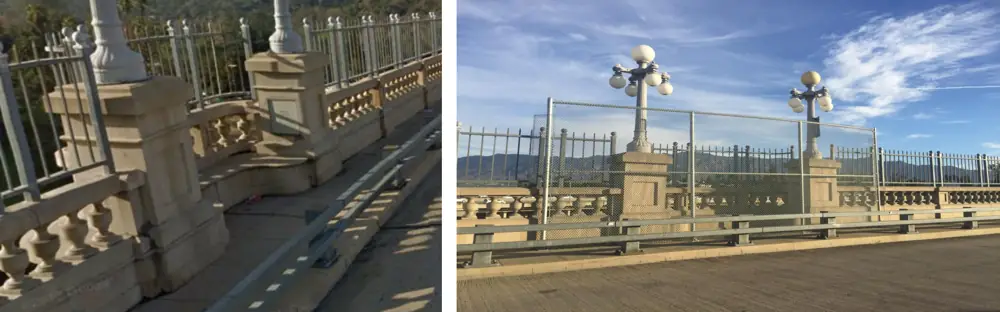
Figure 4. A restored alcove before fencing, and temporary alcove fencing completed in July 2017. City of Pasadena presentation. Photograph dates unstated. The precise alcove locations are unconfirmed.
Later in 2017, Public Works Director Ara Maloyan brought together a task force to study what the City should do next. The group included the City’s health officer and public health director, a suicide-prevention specialist from Didi Hirsch Mental Health Services, Police, Fire, architects, engineers, and preservation advocates.5,9
The task force considered physical barriers, netting, patrols, cameras, motion sensors, crisis phones, signs, lighting, and changes to landscaping and railings. One suggestion was to plant hedges below the bridge to spell “HOPE.” Some ideas were meant to keep a person from reaching the edge. Others were meant to make an intervention more likely.5,7
Some of those broad choices were not new. More than 80 years earlier, Pasadena had considered fencing, netting, and a police presence, and the bridge’s appearance had been a concern then as well.2,35 This time, the City moved quickly to put temporary fencing around the alcoves, but choosing a permanent barrier design would take much longer.2,4,28
Over Labor Day weekend in 2018, first responders spent 13 hours helping a person return to safety. Afterward, the City Manager issued an emergency purchase order for temporary fencing 10 feet high along the bridge’s full length.4,28
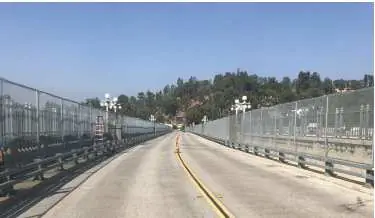
Figure 5. Temporary chain-link fencing along both sides of the bridge, as shown in the City’s November 2019 presentation. City of Pasadena.
A Police Department table presented to the committee in 2021 recorded 10 deaths in 2017, before the full-length fence, and four in 2018, the year it was installed. In the years that followed, it recorded one in 2019, none in 2020, and one through June 13, 2021. Pasadena Now quoted then-City Manager Steve Mermell in September 2018 as saying that nine people had died at the bridge in 2017. The difference remains unexplained. The available records do not provide a complete year-by-year count for recent years.3
A barrier can save a life by creating time. An immediate suicidal crisis can be brief, even when a person’s distress has lasted much longer. A barrier can delay or interrupt an attempt, giving the immediate crisis time to ease and first responders time to arrive. A physical barrier begins providing protection before anyone has noticed the crisis or arrived to help.5,19,29
The full-length fence changed the bridge’s appearance and restricted access. Lower death counts followed its installation. The temporary fence remained in place as Pasadena continued reviewing permanent designs.3,4,28
Section 3 of 13 · Open chapter
2018–2019. Pasadena chooses a policy direction
Months before the full-length fence went up, Councilmember Steve Madison supported moving forward with the task-force recommendation and asked staff to provide dimensions or a visual of the proposed barrier before the matter reached the full Council, according to the official minutes of the April 18, 2018 Public Safety Committee meeting. Tornek specifically requested a visual showing the scale of the proposed barriers. The task force’s written recommendation set a minimum barrier height of 7 feet 6 inches above the highest foothold, not simply above the walkway. The committee unanimously forwarded the recommendation to the Council.6
On April 23, Public Works presented the task force’s recommendation to the full City Council. Staff reviewed the alternatives the group had considered, including patrols, technology, netting, landscaping, and vertical barriers.7
Councilmember Hampton asked staff to consider temporary fencing at the bridge’s ends and approaches until a fence based on an approved design could be constructed.6
Councilmember Andy Wilson asked whether restricting access at the Colorado Street Bridge would simply push people to another location. Public Health Director Michael Johnson said research on barriers at bridges known for suicide suggested that they can reduce overall deaths rather than simply shift them elsewhere. Councilmember Victor Gordo followed up, asking whether a barrier would reduce suicides across the region or merely shift where they occurred. Johnson said the research showed an overall decline after barriers were installed and referred to a Toronto study.7
The discussion also briefly turned to the bridge’s transportation role. Councilmember Gene Masuda asked whether pedestrians could simply be prohibited. Maloyan said banning pedestrians from the bridge wouldn’t be enough. Preventing access would also require closing the bridge to vehicle traffic, which he called impossible.7
When Councilmember Margaret McAustin asked what the design consultant would actually study, Maloyan said the next phase would focus specifically on vertical barriers. The consultant would develop different versions of a barrier and bring them through review by preservation experts, designers, and the public.7
Tornek predicted that the night’s agreement was probably the highest level of consensus the process would reach.7
At the end of the discussion, Madison moved the staff recommendation, Hampton seconded it, and the Council unanimously adopted the task force’s direction toward a permanent physical deterrent.6 The task force’s recommendation centered on a physical barrier designed to keep people from reaching the edge. Other measures could still play a role, but the barrier became the foundation of the City’s approach.5,6
The Council had agreed on a barrier, but its design was still unsettled. In May 2018, it set aside $400,000 for environmental and design work. Public Works began seeking a consultant that October and interviewed two firms in February 2019.8
The Public Safety Committee considered the proposed contract on April 17, 2019. According to the official minutes, Tornek said the schedule was too slow given the urgency of the issue. Madison warned that rushing projects had led to community and Council opposition before, especially when a historic landmark was involved. He still supported a revised timeline and asked staff to review the proposed budget and look for grants. 8
When the committee returned to the contract on May 15, the official minutes record that Madison moved the revised recommendation, Tornek seconded it, and the committee approved it unanimously. At its May 20 meeting, the full Council approved the contract. Public Works had shortened the design schedule by 10 months and reduced the proposed consultant contract from $700,000 to $500,000. At that point, construction was expected to begin around August 2020, provided the City approved additional construction funding.8
Even with the shorter design schedule, Wilson called it “almost a four or five year project.” Madison had warned against rushing.8 The years that followed were not a rush.
Section 4 of 13 · Open chapter
2021. Selection is deferred
By August 2021, more than three years had passed since the City Council’s April 2018 decision to pursue a vertical barrier. The project had involved design work, public outreach, commission review, and full-scale mockups. The committee now had to decide whether to recommend a design, keep the temporary fence in place for the time being, or take another course.7,9
Responses to the mockups
Option B led among the 1,038 respondents who ranked the mockups. The public survey drew 2,268 responses overall.
| Design | Votes | Share |
|---|---|---|
| Curved-curved mesh (Option B) | 462 | 44.5% |
| Pickets (Option C) | 360 | 34.7% |
| Curved-straight mesh (Option A) | 216 | 20.8% |
Separately, staff reported that 44% of 622 comments preferred no barriers and a return to the bridge’s original state. These were different response groups. Participation was self-selected, so neither result represents Pasadena residents as a whole.9
After reviewing full-scale mockups, the Historic Preservation Commission voted to recommend Option B with modifications. This was the mesh option the City called “curved-curved.” Its barrier curved inward over the walkway along the entire bridge. Option A curved at the lamp posts and alcoves, with straight sections elsewhere. The Design Commission preferred straight mesh panels between the alcoves and requested further study to improve transparency around the alcoves and light poles. When the issue reached the Public Safety Committee, Pasadena Heritage executive director Sue Mossman said the task force itself still hadn’t agreed on a final design.9
The designers had explained their reasoning at the March 25 open house. Steve Line of Donald MacDonald Architects described mesh as a way to preserve views while making the barrier difficult to climb. He said straight pickets would require a taller structure and changes to the light standards, and would appear more obstructive when viewed at an angle. Those judgments helped explain the team’s preference for mesh.49
Community groups disagreed about the designs and what should happen next. Pasadena Beautiful urged the City to reconsider horizontal netting. 42 Pasadena Heritage didn’t find any of the three mockups acceptable as presented and asked for options that better fit the bridge. 43 In June, the West Pasadena Residents’ Association asked the City to delay implementation while alternatives were studied further. 44
In an August letter, former Pasadena resident Kathleen Clary Miller recalled crossing the bridge as a child and described how much it still meant to her. She supported a permanent barrier and hoped the design would preserve the bridge’s character. 45
A · Curved-straight mesh B · Curved-curved mesh C · Straight pickets
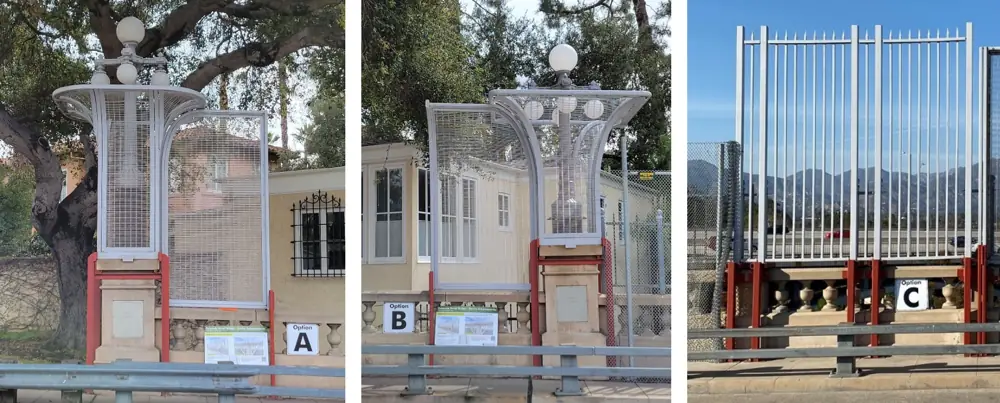
Figure 6. Full-scale mockups from 2021. The red supports were temporary and not part of the proposed designs. City of Pasadena / Donald MacDonald Architects.
Mossman had made the preservation problem plain as early as 2018. Keeping people from the edge was only one goal. The harder task was protecting people while preserving the bridge’s historic character and appearance.23
The August committee discussion
At the August 18, 2021 Public Safety Committee meeting, Madison said the temporary fencing had been effective. He also brought up “coupling,” a concept he recalled from Malcolm Gladwell’s 2019 book Talking to Strangers. Gladwell’s account draws on peer-reviewed suicide-prevention studies. The idea is that a suicidal crisis can become tied to a particular place or method. Making access harder can interrupt an attempt without necessarily moving it somewhere else. 11, 30, 32
Researchers use the term “suicide hotspot” for an accessible place where people repeatedly die by suicide and that becomes known for those deaths. A Vancouver study found that some people chose well-known bridges over others closer to home. The researchers suggested that a bridge’s reputation might help explain that pattern.40
On the design question, Madison was not ready to choose. He proposed narrowing the field to two options and taking them through another round of community input.9
Kennedy, who had chaired the committee in 2017, wanted to narrow the options and put the project on a timetable. At the same time, he supported going out “one last time” for additional local expertise to help the City get the decision right.2,9,11
An earlier proposal from Kennedy was also still under consideration. Back in February 2020, he had asked for a cost estimate for enclosing the bridge with a roof before the Council considered it. The February 2020 presentation compared straight mesh, pickets, curved mesh, and a hybrid. Its schedule called for installing mockups in March, commission reviews in April, and a committee recommendation and Council approval in May. 4, 10 The City later showed an initial enclosure concept to the task force, including Pasadena Heritage and police and fire representatives. The concept wasn’t accepted because of concerns about appearance and safety. 10
At that August meeting, Steve Line of Donald MacDonald Architects presented refined enclosure concepts to the committee. He said one performed especially well when measured against the team’s three design goals of effectiveness, historic compatibility, and appearance.11
Hampton said he had thought Kennedy’s original enclosure idea was a strong one, but wanted something that looked less modern. Madison was more skeptical. He questioned whether preservation advocates or the broader public would accept a barrier that fully enclosed the bridge. Kennedy, who had raised the idea, was now ready to move away from it and narrow the field to the vertical-barrier options.9,11
When Mayor Victor Gordo, who chaired the Public Safety Committee at the time, spoke later in the meeting, he picked up the idea Madison had raised about place and method. He said the temporary structure appeared to be working and that “the decoupling, if you will, has started.” But he still didn’t think the committee was ready to narrow the permanent designs and called for more options and more public input.11
Gordo also took up Kennedy’s enclosure concept. He said he had initially thought full enclosure would never work and had pictured something more like a tunnel. After seeing the refined work, however, he said he liked “the idea of pursuing the material,” wondered whether a different material could be used for the arch-like elements, and said the City shouldn’t rule the concept out.9,11
Staffing and further review
Hampton also said the temporary structure was working and proposed staffing the bridge 24 hours a day. City Manager Steve Mermell said staffing had been suggested before, would likely cost several hundred thousand dollars a year, and wasn’t feasible as a replacement. He recommended leaving the temporary structure in place until a permanent solution was found.11
Gordo used Pasadena’s former Host/Guide program as a model. Trained people would carry radios and serve as additional eyes and ears. He suggested pairing that approach with the City’s ROSE youth-employment program, docents, or tours. Madison pointed to the bridge’s length, curvature, and how quickly some incidents happen. Kennedy raised liability and intervention concerns. Gordo asked staff to see whether staffing could work alongside a physical barrier. 11
“Get it right” became a refrain during the meeting. Mermell, Kennedy, Gordo, and Hampton used the phrase or variations at least nine times, eight within a span of 25 minutes. Near the end, Mermell summarized the requests for more time and a faster result. He then said three months was probably too aggressive and acknowledged that the process ahead would take longer.11
Kennedy also wondered whether the pandemic might help explain why no deaths were recorded at the bridge in 2020 and suggested the question was worth studying. Deaths had already fallen to one in 2019, before the pandemic.3,11
The committee made no selection. The project went back for more design work, community input, and analysis.9,11
John J. Kennedy died on July 21, 2022, while serving on the City Council and only weeks after winning reelection. He had represented District 3 since 2013. Justin Jones was appointed later that year to represent District 3 and would take Kennedy’s place in the bridge discussions that followed. He later won the seat in the March 2024 special election.12
Section 5 of 13 · Open chapter
2022. The first design cycle resets
In September 2022, Public Works returned to the Public Safety Committee with a project reset. The first design cycle, which began with the Donald MacDonald Architects contract in May 2019, had produced three vertical-barrier concepts and the full-scale mockups installed in March 2021.4,8 The committee had declined to recommend one in August 2021.9
Afterward, City staff and Pasadena Heritage looked for new design ideas through the Southern California chapter of the Institute of Classical Architecture & Art. By September 2022, staff was preparing to remove the old mockups, restore the temporary fencing where they had stood, and hire a new design consultant. The report expected a new consultant by December 2022 or January 2023, followed by design work through June and a return to the committee around September 2023. 4
The next contract didn’t arrive in that window. The first request for proposals drew none, so the City reissued it. Pasadena awarded the new design contract to Apexx Architecture on April 14, 2023, several months after the schedule in the September report.13,24 Pasadena had ended one design cycle and was starting another.
Section 6 of 13 · Open chapter
2023. Previously considered alternatives return
Apexx worked with community and preservation representatives and gathered public input as it developed a new set of barrier concepts. By the November Public Safety Committee meeting, three were under consideration. They were canted webmesh, vertical webmesh, and metal pickets. The webmesh designs used metal mesh stretched between posts, either upright or angled. The picket design used a row of closely spaced vertical metal bars.13,14
Canted webmesh Vertical webmesh Metal pickets
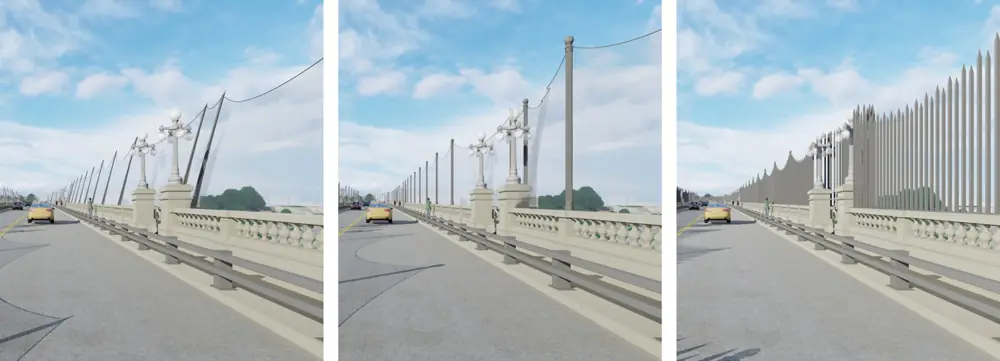
Figure 7. Three proposed barrier concepts presented in November 2023. Renderings of proposed designs, not built conditions. Apexx Architecture / City of Pasadena.
At that meeting, the committee returned to questions Pasadena had considered before. Madison, who had moved approval of the task force’s recommendation in 2018, described many suicide attempts as crisis-specific and impulsive and recalled a documentary about people who had survived attempts at the Golden Gate Bridge.6,14
Madison turned to the new designs. He said they would “completely change the aesthetic of the bridge,” while also saying the City had to “elevate human safety over aesthetics and objects.” He added, “But if there’s a way to accomplish both goals, I think we’re going to be more successful.”14
Madison then asked about horizontal netting and landscaping below the bridge. Staff said both had already been studied. Staff explained that the Golden Gate approach did not translate neatly because of the Colorado Street Bridge’s geometry, the remaining fall distance, structural demands, and the appearance of a net below the arches. The 2018 task-force recommendation report said “no verifying scientific data was found” for planting trees below the bridge to “cushion” a landing or discourage an attempt. The same report said trees could not be planted along approximately one-fifth of the span, including its highest point. The task force treated trees as a possible supplement to a vertical barrier.5,14
After hearing those answers, Madison wasn’t ready to support any of the three permanent designs. He suggested the temporary fencing might be preferable to what was being proposed and said it would take a significant change in community sentiment for him to support one of the three concepts.14
Jones was newer to the bridge debate. He hadn’t been part of the Council’s 2018 decision or the committee’s 2021 discussions. At the November 2023 meeting, he raised concerns from residents who disliked both the temporary fencing and the proposed permanent designs. He asked what other options were available. Staff said the alternatives had already been studied extensively and the Council had chosen to pursue a vertical barrier. 12, 14
Jones also asked how involved Public Health had been in the new working group. He wanted to know whether restricting access at one site simply shifted attempts elsewhere. Staff pointed to the mental-health specialist involved in the process. They explained that interrupting access to a selected site generally didn’t send people to the next bridge and agreed to bring health professionals when the project returned. The Council had considered the same question on April 23, 2018, when Public Health said research showed an overall decline after barriers were installed. 7, 14
Gordo returned to the staffing idea he had raised in 2021. Deputy Director of Public Works and City Engineer Kris Markarian said the City had already examined staffing and didn’t consider it cost-effective. Covering the bridge would require several people and a continuous presence. It’s long, curved, and can’t be seen from one point. She also cited liability concerns and incidents outside regular working hours. Staff considered stationed personnel a possible supplement to a physical barrier. 15
Gordo asked for a more specific assessment of trained security at night and Park Safety specialists, docents, or volunteers during the day. Madison questioned whether personnel could respond quickly enough because some incidents can “unfold in five minutes.” Gordo asked staff to consult mental-health professionals about whether a visible human presence could deter an impulsive attempt.15
Near the end of the November 2023 meeting, Public Works Director Tony Olmos and Markarian again explained that a barrier buys time.14
No permanent design was selected. The committee kept the planned commission reviews and public survey moving while asking staff to return with additional work on staffing and other alternatives.14,15
At its December 5, 2023 review, the Historic Preservation Commission recommended vertical webmesh as its first choice and metal pickets as its second.16
Section 7 of 13 · Open chapter
2024. The requested answers come back
January’s Design Commission review
When the designs reached the Design Commission in January 2024, its formal assignment was to advise the Council on aesthetic design concepts. The discussion nevertheless moved beyond the appearance of the three designs and returned to whether other safety measures might work.33
Chair Julianna Delgado cited the Golden Gate Bridge and asked whether horizontal netting, landscaping, or another measure could be used instead. An off-camera speaker said horizontal netting had been studied since 2017 and traced the City’s vertical-barrier direction to the task-force review and the Council’s 2018 decision. According to the speaker, a net would create construction, rescue, training, equipment, cost, and architectural problems specific to the Colorado Street Bridge. They said the research the City had reviewed supported a vertical barrier as the most effective option. They also noted that the City’s previous consultant, Donald MacDonald Architects, had served as lead designer of the Golden Gate system and had considered dozens of alternatives for Pasadena before the City retained a new consultant.5,6,33
Delgado then asked whether the public had been shown a horizontal option. The speaker said it had, but that the Council had directed the City to pursue a vertical barrier. Delgado replied that this was “a previous City Council and a long time ago.” One commissioner said the Golden Gate and Colorado Street bridges were structurally different and that a net below the Colorado Street Bridge would compete with its arches. Delgado argued that a net could be placed farther below, suggested planting cacti beneath the bridge, and repeated a public suggestion to construct apartment buildings there. A responding speaker noted that bungalows already existed below the bridge and said the safer approach was to keep people from leaving the bridge deck.33
Later in the meeting, Delgado said she couldn’t support any of the three designs. She said there had to be a better solution and that she didn’t want any of the presented barriers on the bridge.33
Other commissioners expressed different preferences. Pasadena Now reported that Srinivas Rao favored the canted mesh but wanted further refinement. Marie-Claude Fares preferred webmesh and criticized the effect of pickets on views from the bridge and its surroundings. Robert Carpenter said he found it difficult to accept any of the proposals.50
The commission did not reach consensus on any of the designs. Its advisory comments called for further study of the metal pickets and canted webmesh, including the angle and details of the canted design, and consideration of combining pickets with webmesh.33
July’s committee review
When the project returned to the Public Safety Committee in July 2024, staff gave a more detailed answer to Delgado’s question about horizontal netting. By then, staff’s options had narrowed to vertical webmesh and metal pickets. The July presentation listed canted webmesh as eliminated. Staff also returned with much of what elected officials had asked for, including patrol costs, technology analysis, horizontal-netting research, Golden Gate consultation, rescue concerns, survey results, and suicide-prevention expertise. 16
The committee also heard from Bonnie Tang, whose son Nicholas died by suicide at the bridge in April 2021. She shared her family’s loss as part of the presentation. Committee members expressed condolences and thanked her for speaking.18
Horizontal netting came back with a much fuller engineering and rescue review. The original 2018 task-force comparison had rated it relatively highly for effectiveness but poorly for aesthetics and its impact on emergency services.17 By 2024, after preliminary site-specific engineering work and direct consultation with Golden Gate Bridge officials, Pasadena’s review concluded that horizontal netting wasn’t a viable solution for this bridge.16,18
Fire Chief Chad Augustin explained what a rescue could require. Someone who landed on a net could be 10 or 20 feet below the bridge, making it difficult for police to determine whether the person had a weapon or whether rescuers could safely approach. A rescue could require both of Pasadena’s ladder trucks for hours, along with specialized equipment and additional training. Augustin supported having a barrier on the bridge, but he couldn’t recommend horizontal netting from a public-safety standpoint.18
2017 · Safety-netting concept
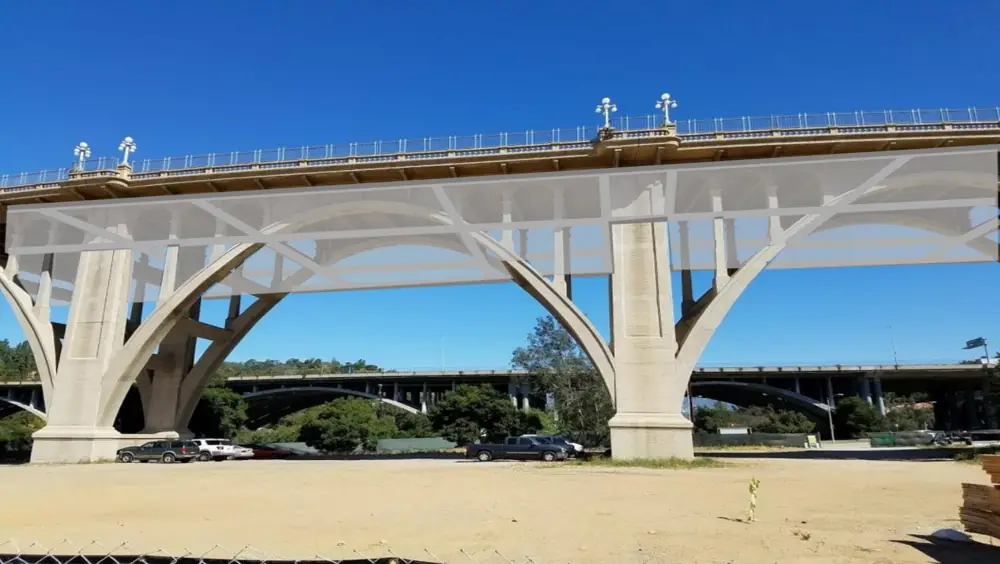
2024 · Preliminary horizontal-netting Option 1
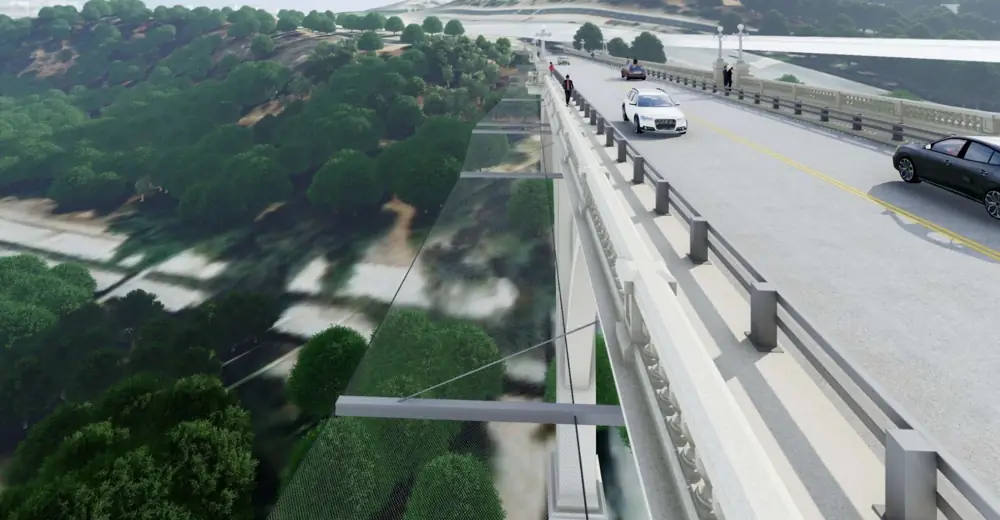
Figure 8. Horizontal-netting concepts presented in 2017 (top) and 2024 (bottom). Renderings of proposed designs, not built conditions. City of Pasadena.
The committee also received the requested patrol costs. The estimate was roughly $600,000 a year for private security and about $1.16 million a year for law-enforcement coverage. Even at those levels, patrol wasn’t considered an effective substitute for a physical barrier.16
The public survey drew 678 responses overall. The City reported that 57% of those answering the need question said a vertical barrier wasn’t needed and 43% said it was. Asked separately whether a vertical barrier would help prevent suicides, 40% said yes, 33% said no, and 27% didn’t know. Some respondents skipped the design ranking, so the overall response count should not be assumed to apply to every question. People chose whether to take the survey, so its results cannot be treated as the views of Pasadena residents as a whole. Staff said 90% of respondents were Pasadena residents, and 74% said they hadn’t participated in the project’s community meetings.19
Among respondents who ranked the designs, metal pickets came first, while the Historic Preservation Commission had preferred vertical webmesh. Lighting drew broader support. The City reported 81% support for added lighting in the survey, and the commission unanimously supported lighting under the balustrade.19
Markarian, then acting director of Public Works, said they pointed to a need for “additional education.” Sandri Kramer of Didi Hirsch was even more direct. With roughly 60% of respondents either unconvinced that a vertical barrier would prevent suicides or unsure whether it would, she called it a “public education issue” and explained why restricting access can save lives.18,19
Kramer focused on the time between suicidal intent and an attempt. She explained that restricting access can give the immediate danger time to ease or give someone a chance to intervene. 19
A separate study of England’s Clifton Suspension Bridge illustrates how that can work. After barriers were installed, bridge staff reported that they had more time to reach people, while deaths fell even though the number of incidents did not. The bridge also used cameras and staff patrols.29
Members weigh the next step
Jones’s questions moved the discussion toward a decision. He asked whether 24/7 patrol was being ruled out because of cost, effectiveness, or both. Staff said both. He then asked whether anyone involved in the expert review had recommended horizontal netting. Staff said no. The recommendation against it had been unanimous. After hearing those answers, Jones said he was prepared to move forward with one of the two remaining designs.18
Hampton pressed for a faster timetable. He asked staff to return in about 90 days and said vertical mesh was his preferred permanent design. He also raised cameras and motion detection as possible supplements. Later in the discussion, staff said horizontal netting hadn’t been recommended, and Fire explained its rescue concerns. Hampton said he didn’t want netting taken off the table. He still considered it the most attractive of the alternatives. 20, 21
During that follow-up, Hampton asked about rescue cushions. Fire Chief Chad Augustin said Pasadena’s cushion was rated for roughly 100 feet, while parts of the bridge are about 150 feet high. The equipment also couldn’t be positioned everywhere below it. Hampton then asked whether a higher-capacity cushion existed, a question the City hadn’t already answered. Fire didn’t know and agreed to investigate. A May 2026 Fire Department presentation listed a rescue cushion among its response resources, but gave no capacity rating. The equipment list doesn’t answer Hampton’s question. 21
Eight months after the November discussion of netting and landscaping, Madison again turned to measures below the bridge. He said the City needed an engineering solution and asked about ground cover, physical impediments, and layered netting. Staff and consultants again explained the limits involving fall distance, structure, cost, and what those measures would do to the appearance of the bridge. Madison also repeated his view that human life and safety had to come before objects.18,22
During that exchange, Madison acknowledged that leadership sometimes meant proceeding without a great option. He asked Markarian, “Do you feel like we’ve really done our level best to exhaust all the feasible options?” Markarian described more than seven years on the project and experts with different perspectives. She said, “we have truly exhausted various mitigation measures,” before discussing the Golden Gate comparison.18
Gordo asked about cameras and real-time remote communication with a person on the bridge during a crisis. Staff considered these tools possible additions to a physical barrier.18
Jones supported moving forward with one of the two remaining vertical designs, and Hampton preferred vertical mesh. Horizontal netting, below-bridge alternatives, and technology remained in the discussion. No permanent design was sent to the full Council. Staff proposed further design work, public feedback, and commission review before a return to the committee in early 2025. 18, 20, 21
Section 8 of 13 · Open chapter
The record by July 2024
Questions that returned
Some discussions revisited earlier findings. Others led to more detailed cost, engineering, and rescue analysis.
Selected discussions. Dates identify the records summarized, not necessarily the first time a question was raised.
Section 9 of 13 · Open chapter
2025–2026. The schedule moves again
The July 2024 timeline didn’t hold. Staff had laid out a probable schedule for refining the concepts through the summer and fall, returning to the Historic Preservation and Design commissions, and coming back to the committee early in 2025.18 By June 2025, construction of new test panels had only begun.26
In July, the San Rafael Neighborhoods Association publicly pressed the City to make a decision. Responding to Pasadena Now, City Engineer Brent Maue said full-scale mockups were being built for internal evaluation. He anticipated presentations to the Design Commission, Public Safety Committee, and City Council beginning later that summer and continuing into fall. Installation of mockups on the bridge for public feedback would depend on those reviews.46
Pasadena’s fiscal year 2026 ran from July 2025 through June 2026. In its first-quarter report for fiscal year 2026, the City anticipated a final recommendation to the Public Safety Committee in the second quarter and moved the design phase’s target completion date from June 30, 2026, to June 30, 2028. A February 2026 second-quarter report said the test panels and review were complete, but presentations to the West Pasadena Residents’ Association and the Public Safety Committee were then anticipated in the third quarter. The June 30, 2028 target remained.26
The project’s appropriations reached $3,050,000, with $950,000 from the General Fund, $100,000 in Gas Tax funding, and $2 million labeled ARPA. In 2025, the Council transferred $130,000 on June 9 and $46,000 on July 21 to the San Rafael Bridge Seismic Retrofit project, reducing the total to $2,874,000. Staff said enough remained to finish design without affecting its progress. Construction still required additional funding.41
At a special joint Finance Committee and City Council meeting on April 20, 2026, staff reported about $1.5 million spent from the design-phase project account, about $1.3 million left to finish it, and a separate construction estimate of roughly $4 million. 31 The records reviewed here don’t confirm construction funding. 28
That account paid for more than architects’ fees. The August 2021 report describes earlier spending on temporary fencing and maintenance, mockups, environmental assessment, conceptual design, and outreach. 9 The report through June 30, 2026, records $1,475,508 in total spending to date for project 73324. It doesn’t break that total down by use. 26
Early in the meeting, Acting City Manager Matt Hawkesworth raised the possibility of redirecting the unspent bridge money to other priorities. He said Pasadena had made “the shortlist for an earmark potentially in the next budget cycle” for $4.5 million. Public Works Director Greg de Vinck described it as a shortlisted grant application and said redirecting the bridge money would leave Pasadena without the required matching funds.31
Later, Councilmember Rick Cole asked how much Pasadena had already spent and whether the remaining money would pay for a finished barrier. City Engineer Brent Maue said the remaining money was expected to cover the design. Construction would need additional funding. He estimated construction at roughly $4 million. 31
Federal funding remained uncertain. Rep. Judy Chu’s published request for fiscal year 2027 listed $4 million for the bridge. A House committee report dated June 5, 2026, recommended $1 million. The records don’t establish whether the $4.5 million discussed in April referred to that request or what “shortlist” meant. Pasadena’s project page continued to say construction funding hadn’t been identified. 31, 34
The schedule slipped again. In its third-quarter report for fiscal year 2026, the City pushed the expected Public Safety Committee presentation into the fourth quarter. The year-end report, covering work through June 30, said Pasadena Heritage was still reviewing the concepts and listed the design phase as ongoing.26 Pasadena Heritage helped develop and review concepts, but a permanent design still needed City Council approval.4 By then, the City had spent $1,475,508, or 51% of the $2,874,000 set aside for the design-phase project. Its target completion date remained June 30, 2028, but the report no longer said when the project would return to the committee.26
The Public Safety Committee has a new chair, Vice Mayor Jess Rivas, with Hampton, Jones, and Madison remaining as members.27 The official records reviewed here show no final permanent-design approval or construction award.26,27,28
Section 10 of 13 · Open chapter
Published schedules
How the forecasts changed
The forecasts below concern construction, design approval, or a return to the committee. Each is paired with the later record. The fiscal year 2026 reports repeatedly moved the expected committee return, then omitted a return date in the year-end report. 26
The June 30, 2028 target concerns completion of design.26
Section 11 of 13 · Open chapter
Not every delay is the same
The project faced practical constraints. Work on a protected historic structure had to account for anchoring, maintenance, emergency access, whether the changes could later be undone, and historic character. COVID-19 delayed getting materials and building the mockups. The first request for a replacement design consultant also drew no proposals. 1, 16, 24
The pandemic also affected planned funding. In April 2020, the City dropped a proposed new $2 million General Fund appropriation for the bridge from its fiscal year 2021 capital budget to keep money available for essential services. The adopted budget didn’t add a new appropriation for the project and said design would continue, with construction to begin when funds became available. 47
How to pay for construction remained unresolved. Pasadena had funded the design work, but building the permanent barrier would require separate funding. The Eaton Fire required a major City emergency response in January 2025. The bridge records reviewed here don’t link it to a specific project delay. 24, 25, 28
The record also shows real progress. Pasadena chose a physical barrier, funded design work, hired specialists, developed full-scale mockups, and shortened the design schedule by 10 months. Former Pasadena Heritage executive director Sue Mossman later wrote that the process had taken “much longer than anticipated” and that, after so many options and trial runs, “no solution is going to be perfect.”6,8,23
After the Council chose a physical barrier, staff returned with more detailed engineering, cost, and rescue analysis. Some discussions continued to revisit alternatives the City had already studied. 6, 14, 16, 18 Staff concluded that patrols could supplement a barrier but couldn’t replace one. Horizontal netting ran into engineering and rescue problems specific to this bridge. 15, 16, 18 The 2024 survey also showed substantial doubt among respondents about whether a vertical barrier was needed or would work. 19
By July 2024, officials differed over what to do with the answers staff had provided. Jones moved toward a choice. Hampton named vertical mesh as his preferred design but asked that horizontal netting stay on the table. Madison continued to press for measures below the bridge. Gordo kept staffing and technology in the discussion.11,14,15,18,20,21
Mayor Terry Tornek had warned about this in 2018. He said, “This is probably the highest level of consensus we’ll achieve in this process, I predict.” He said agreement would become much harder once specific designs were presented. A few minutes later, as councilmembers debated height and curvature, he called it “a harbinger of the discussion to come.” 7
More than eight years have passed since the Council’s April 2018 decision.6 That span reflects, in part, the difficulty of turning agreement on protection into agreement on a design.
Section 12 of 13 · Open chapter
Where that leaves Pasadena
Fewer people died at the bridge in the first few years after the fence went up. Those lower counts were recorded while access remained physically restricted. They don’t establish what would happen without the fence. 3, 28 In an oral update at the November 2023 committee meeting, a Police Department lieutenant reported deaths at the bridge in 2022 and 2023. The risk hadn’t disappeared. 3
Auckland, New Zealand, offers a documented warning. Grafton Bridge had suicide barriers for decades before the city removed them in 1996 amid concerns about their appearance, effects on the historic structure, and interference with rescue operations. Researchers recorded three deaths from the bridge in 1992–1995, before removal, and 15 in 1997–2000, after removal. After improved curved-glass barriers were installed in 2003, researchers recorded no suicides from the bridge during the following four years, describing the sequence as a natural experiment in what happens when a physical deterrent is present, removed, and restored. Low death counts may show that a barrier is working. They do not mean a bridge has become permanently “decoupled” from the risk of suicide.29
A city shouldn’t need another rise in deaths to remember why access was restricted in the first place.
The chain-link fence was installed in response to an emergency.28 It remains in place while Pasadena works toward a permanent design that can provide effective protection and preserve the bridge’s historic character.4,14,16
Construction funding remains unresolved. 28 The City transferred $176,000 from the design-phase account in 2025, though staff said enough remained to finish design. 41 When officials discussed moving more money in April 2026, Public Works warned that doing so would leave Pasadena without matching funds for a shortlisted application. 31
If Pasadena decides to keep the existing fence, it should explain why and how it’ll maintain effective protection. If people remain unhappy with how the fence looks, pressure to remove or weaken it could grow. 28, 29
Its effect on the bridge is visible every day. The deaths it may prevent are not.3,28
Section 13 of 13 · Open chapter
In memory
This paper is dedicated to the people who died by suicide at the Colorado Street Bridge, including those whose names are not included in the surviving public record.
If you or someone you know is struggling or in crisis, call or text 988 to reach the 988 Suicide & Crisis Lifeline.