An analytical history
The fence everyone can see
Reading edition · October 22, 2026 · About 40 minutes, excluding Sources
Main research cutoff: September 1, 2026. Later checks and additions are dated where they appear.
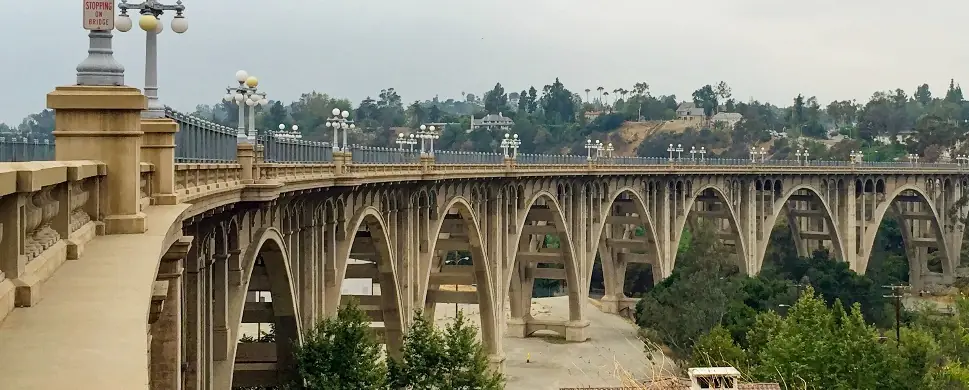
Figure 1. The bridge after its 1993 restoration, showing its curve and arches across the Arroyo Seco. BCA Associates.
The Colorado Street Bridge has carried two reputations for generations. It’s one of Pasadena’s great landmarks, a 1913 concrete span over the Arroyo Seco that has become part of the city’s identity. It’s also known as “Suicide Bridge.”2,35
Before it opened, crossing the arroyo meant descending into the ravine and climbing out again. The earlier wooden Scoville Bridge crossed the stream below, leaving travelers to negotiate the steep approaches. That was difficult for horse-drawn vehicles and early automobiles. The new bridge carried Colorado Street across the ravine at street level.48
Engineer John Alexander Low Waddell’s design was adapted by builder John Drake Mercereau.1 Its sweeping curve helped the builders avoid unstable ground when placing the foundations. Construction began in July 1912. On December 13, 1913, residents celebrated the opening with a parade of decorated automobiles.48
The bridge later carried Route 66 across the arroyo.48 An earthquake retrofit and restoration completed in 1993 reconstructed its concrete balustrades and seating alcoves and restored the historic lighting design.36
The bridge is listed on the National Register of Historic Places, documented by the Historic American Engineering Record, and designated a Pasadena Cultural Heritage Landmark. Pasadena’s Bridge Party, a tradition dating to 1978, celebrates the bridge and the efforts to preserve it.1,37
Its big-screen history reaches back to Charlie Chaplin’s The Kid (1921), which used the bridge for a scene in which Edna Purviance’s character considers suicide.38 Nearly a century later, it appeared in La La Land (2016).39 The bridge has been a setting for stories, a gathering place, and a landmark people have worked to preserve. But its other history never went away.