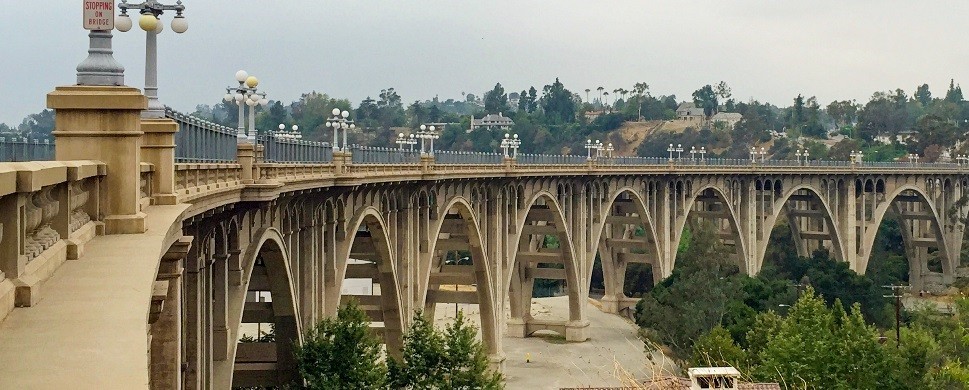
Colorado Street BridgeEvidence & limits

What does the evidence tell us?

Read the prevention studies, local surveys, and financial records, with the limits of each.

For support, contact the 988 Suicide & Crisis Lifeline: call 988 or text 988.

What the local death counts show

Available counts, with gaps and partial years

The available figures do not give a complete total since the full-length temporary fence was installed in September 2018. The police table and later oral updates cover different periods and are shown separately below.

Police Department table presented August 18, 2021
Year or periodDeaths
20154
20162
201710
20184
20191
20200
2021 through June 13 only1

The table covers January 1, 2015 through June 13, 2021. Pasadena Now quoted then-City Manager Steve Mermell in September 2018 as saying that nine people had died at the bridge in 2017. That difference remains unexplained. The 2018 figure covers time both before and after full-length fencing. The final row is not a full-year 2021 count.

2021 staff report · Police tables · p. 2 Transcribed death and incident tables

Separate oral update at Public Safety on November 15, 2023
Year or period reportedDeaths reported
20224
2023 as of the November 15 meeting2

Police Lieutenant Brad May reported these figures and distinguished deaths from attempts. Public Works Director Tony Olmos later repeated them and specified that they concerned the bridge.

May’s oral update · go to 00:25:22 Olmos’s clarification · go to 00:56:12

The oral figures and approximate times were previously checked against the official recording. They are not a reconciled annual dataset. The reviewed records include only partial counts for 2021 and 2023 and do not supply counts for 2024–2026. Do not combine these fragments into a complete “since the fence” total, treat missing years as zero, or use the table alone to measure the fence’s effect. Death counts and the report’s separate incident categories should not be added together.

What prevention research supports

Why a barrier can help

A barrier can create time

The research describes how interrupting access can allow an immediate crisis to ease or create an opportunity for intervention. The Clifton Suspension Bridge study reported fewer deaths and staff accounts of more time to intervene, even without fewer incidents.

Clifton also used cameras and patrols, so the study cannot show that extra time alone explained the results. Research on how long a crisis lasts also does not give one timeline that applies to everyone.

Would deaths move elsewhere?

Deaths do not necessarily move to another site

The research summarized here challenges the assumption that restricting one site simply moves every death elsewhere. Longer follow-up can also change an initial finding, as it did at Toronto’s Bloor Viaduct.

The 2025 review combined results from several studies. It found no clear increase at other sites and fewer deaths using the same method overall. It did not detect a reduction across all suicide methods combined, and some comparison-site data were limited.

What the research does not decide about Pasadena’s design

Local design choice

Research does not identify one best design for every bridge

The Swiss study cited in the early City presentations grouped complete vertical barriers and nets together. It did not establish that one type was more effective than the other.

Pasadena’s preference also reflected its own assessment of architecture, engineering, and emergency-services concerns. The 2024 netting assessment still had unfinished engineering work.

Design dimensions

Height depends on the measurement point

The April 2018 task-force recommendation specified a minimum of 7 feet 6 inches above the highest foothold. The City FAQ, checked October 5, 2026, describes 8–11 feet above the nearest toehold and says its presented options use 10 feet. The wording and dates differ, but these statements alone do not show that the City officially replaced the earlier height requirement. Both measure height from a place someone could put a foot, not from the sidewalk.

Public Safety Committee · April 18, 2018 · Presentation · PDF p. 34 City height FAQ

What the local surveys show

2021 survey

Curved-curved mesh (Option B) led among respondents who ranked the mockups

The City reported 2,268 responses overall. Of these, 1,038 respondents ranked the three designs.

Design rankings from 1,038 respondents
DesignVotesShare
Curved-curved mesh (Option B)46244.5%
Pickets (Option C)36034.7%
Curved-straight mesh (Option A)21620.8%

Separately, staff grouped 622 comments by what people said and reported that 44% preferred no barriers and a return to the bridge’s original state.

Option B also matched the Historic Preservation Commission’s April 20, 2021 recommendation, with modifications. The minutes record eight votes in favor, none against, and one member absent. This was the commission’s advisory recommendation.

People chose whether to take part. Their answers do not necessarily represent the views of Pasadena residents as a whole. The design rankings and written comments were counted separately, using different totals. They should not be treated as the same result or compared directly with the later survey to show a change in opinion.

2024 survey

Respondents expressed doubts and design preferences

The survey drew 678 responses overall. On whether a vertical barrier was needed, the City reported 57% no and 43% yes. On the separate question of whether a vertical barrier would help prevent suicides, the City reported 40% yes, 33% no, and 27% don’t know. The records do not show that all 678 people answered every question. Some respondents skipped the design ranking.

Metal pickets ranked highest as the preferred material and design. The City reported 81% support for added lighting and unanimous Historic Preservation Commission support for lighting under the balustrade.

Public Safety Committee · July 17, 2024 · Survey summary · PDF p. 18 · Survey charts · PDF p. 19 · Commission feedback · PDF p. 16

People chose whether to take part. Their answers do not necessarily represent the views of Pasadena residents as a whole. The 2021 results grouped written comments by topic, while this survey asked direct questions. Comparing them does not establish a change in opinion.

What the records say about funding and the schedule

Existing funds are being used, and construction needs more funding

$1.48 million Total spending recorded for project 73324 through June 30, 2026, rounded from $1,475,508.
June 2028 The target for finishing the design.

The project has recorded $1.48 million in spending, and two transfers in 2025 reduced its approved budget by $176,000. Staff said the remaining budget was enough to finish design. The reviewed records do not show secured funding to build the permanent barrier.

The report covering activity through June 30, 2026, lists an approved project budget of $2,874,000. Spending includes temporary fencing, maintenance, and other project work.

Budget details and supporting records

The report at the end of fiscal year 2026 listed a $2,874,000 approved budget for project 73324, titled “Colorado Street Bridge Barrier Enhancements – Design Phase.” The August 2021 report describes earlier project spending on temporary fencing and maintenance, mockups, environmental assessment, conceptual design, and outreach. The cited 2026 project row does not break down that later spending total by category.

The 2021 report estimated $4–6 million to complete design and construction. In April 2026, staff separately estimated construction at roughly $4 million. The estimates cover different work, so comparing them does not show that costs fell.

The approved project budget reached $3,050,000: $950,000 from the General Fund, $100,000 in Gas Tax funding, and $2 million labeled ARPA, the federal American Rescue Plan Act. In 2025, the Council transferred $130,000 on June 9 and $46,000 on July 21 to the San Rafael Bridge Seismic Retrofit project, reducing the total to $2,874,000. Staff said enough remained to finish design without affecting its progress. Construction still required additional funding.

The cited records establish the approved project budget. The amount remaining after outstanding commitments is unresolved, as is the project’s federal ARPA accounting.

FY2023 adopted capital budget, project 73324, PDF p. 8 June 9, 2025 staff report, p. 2 June 9 approved Council minutes, pp. 4 and 6 July 21, 2025 staff report, pp. 2–4 July 21 approved Council minutes, pp. 8–9 and 12

City project page · Checked October 5, 2026.

Financial activity through June 30, 2026. Source row checked September 13, 2026.

More supporting records

What remains unresolved

  • Complete year-by-year death counts for recent yearsPolice tables cover an earlier period. Later oral updates are identified separately. The reviewed records include only partial counts for 2021 and 2023 and do not supply counts for 2024–2026. The records also show an unexplained disagreement between two 2017 counts. 2021 staff report · p. 2
  • What caused each delay, and how long it lastedThe records describe pandemic delays in obtaining materials and building full-size examples, and a first search for a new consultant that received no proposals. The bridge records reviewed do not attribute a specific delay to the Eaton Fire. Repeated discussions alone do not tell us how many months of delay they caused. August 2021 recording · 00:14:14
  • Construction fundingConstruction funding remained unidentified. The program behind April’s $4.5 million “shortlist” and its relationship to the congressional request remain unresolved. April 2026 Finance recording · House committee report

How to use the sources

Source links open the underlying City records, original studies, and official recordings. The times show approximately where each discussion begins in the recording. Open the recording and move to the time shown.

Selected remarks distinguish quotations, caption excerpts, and transcript excerpts. Verification details appear with each selection. Search covers the material shown here, including remarks, but does not search inside linked reports or recordings.